What Is Database Version Control and What Does It Cost You Not to Have It?
It's the question every development lead eventually has to answer in a postmortem: "Who made that change, when was it made, and does it match what's in production?" If your database schema isn't version-controlled, the honest answer to all three is: we don't know.
Database version control has a straightforward definition. It also has consequences that only become visible once something goes wrong. The purpose of this piece is to make those consequences visible before the postmortem forces the question.
Version control for your schema is not a nice-to-have. It is the difference between a deployment that is repeatable and one that depends on someone remembering the right order.
// THE WHOLE ARGUMENT, IN ONE LINE
What is Database Version Control?
Version control is the practice of tracking every change made to a system over time — so you always know what changed, when, who changed it, and why. For application code, this is standard. Every development team uses Git. Every change is logged, every release is tagged, every mistake can be rolled back in minutes.
Database version control applies that same discipline to your database schema. Every change to a table, column, index, stored procedure, or constraint is treated as code — written as a migration script, committed to your repository, reviewed like any other file, and deployed in a controlled, ordered, repeatable way. Not executed manually against a live database by someone who may or may not document what they did.
The analogy is exact: if your application code and your database schema are both part of your product — and they are — they should both be managed with the same level of care. Most teams do one but not the other. The consequences of that gap accumulate quietly until they don't.
What the gap actually costs?
The damage from unmanaged database changes does not usually announce itself as a single event. It stacks up across four layers, and most organizations only measure the one that shows up first.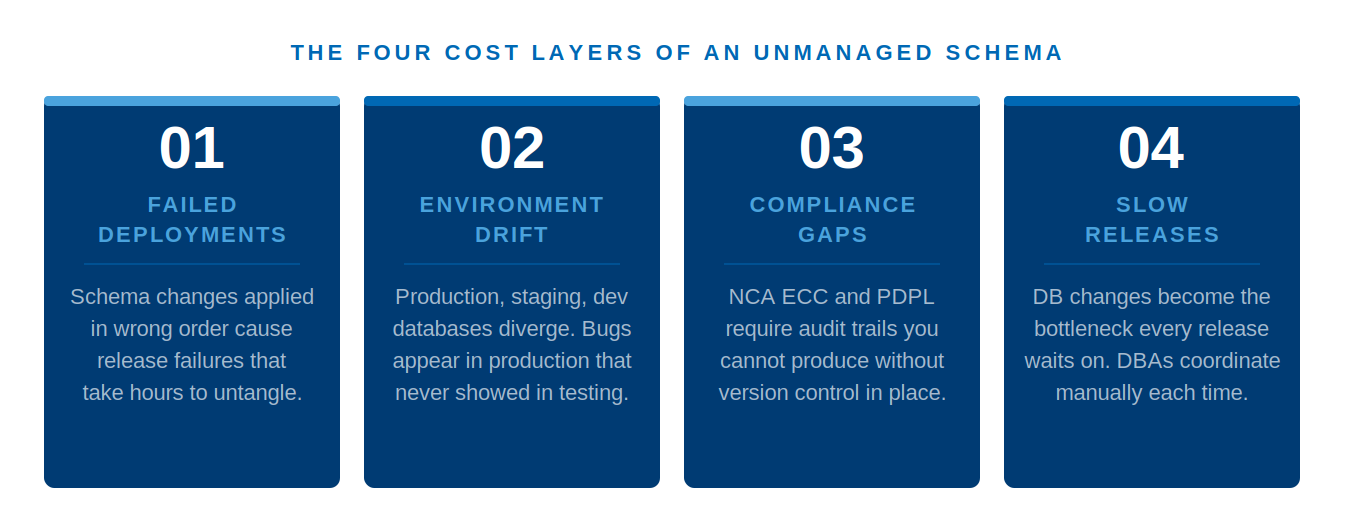
Rule of thumb: if your estimate of the cost of a bad deployment only includes the engineering time to fix it, you're probably underpricing the problem by a factor of three to five. The compliance exposure, the customer-facing impact, and the release delays that follow are where the real cost accumulates.
A 90-minute deployment failure might cost a few hours of engineering time on the surface. It then quietly costs a missed release window, a manual rollback that takes two people half a day, and a compliance report that can't be filed because nobody logged the original change.
// WHAT THE INVOICE ACTUALLY PROTECTS
How database version control actually works
Database version control works by treating every schema change as a migration script — a small SQL file that describes exactly what needs to change and in what order. These scripts live in your source code repository alongside your application code, versioned and reviewed like any other file.
When a deployment runs, the tool checks which migrations have already been applied to the target database and applies only the ones that haven't. Every deployment is reproducible, ordered, and permanently recorded.
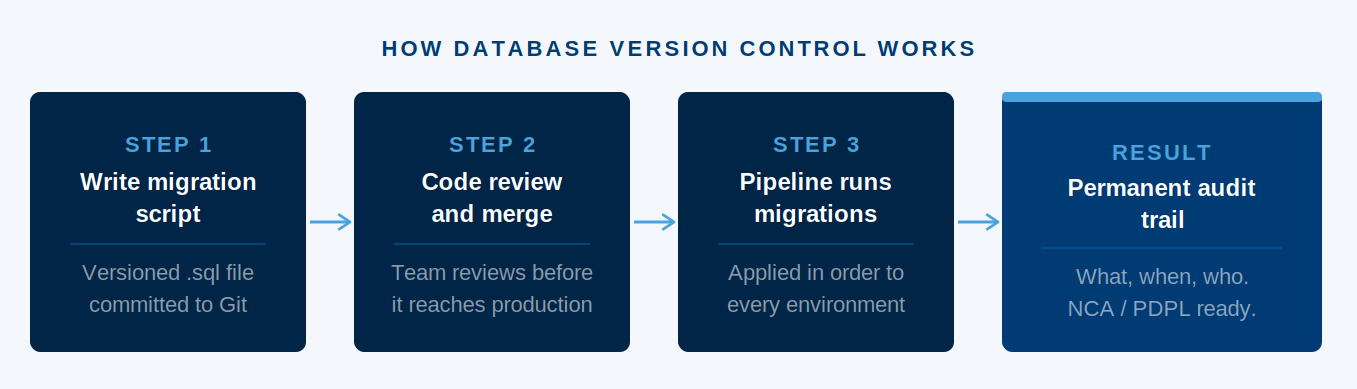
Here's what that looks like in practice. Instead of connecting to a database and running SQL manually, a developer writes a versioned script file — say, V2.1__add_transactions_index.sql — and commits it to the repository. It goes through a pull request. The CI/CD pipeline picks it up and applies it in the right order to development, then staging, then production. The schema history table inside the database records exactly what happened and when. No manual steps. No missing documentation. No "who made that change" postmortem questions.
Without it vs. with it
You don't need exact figures to see the difference. Line up the two columns and the pattern is unmistakable — every operational metric that drives cost moves the right way once version control is in place.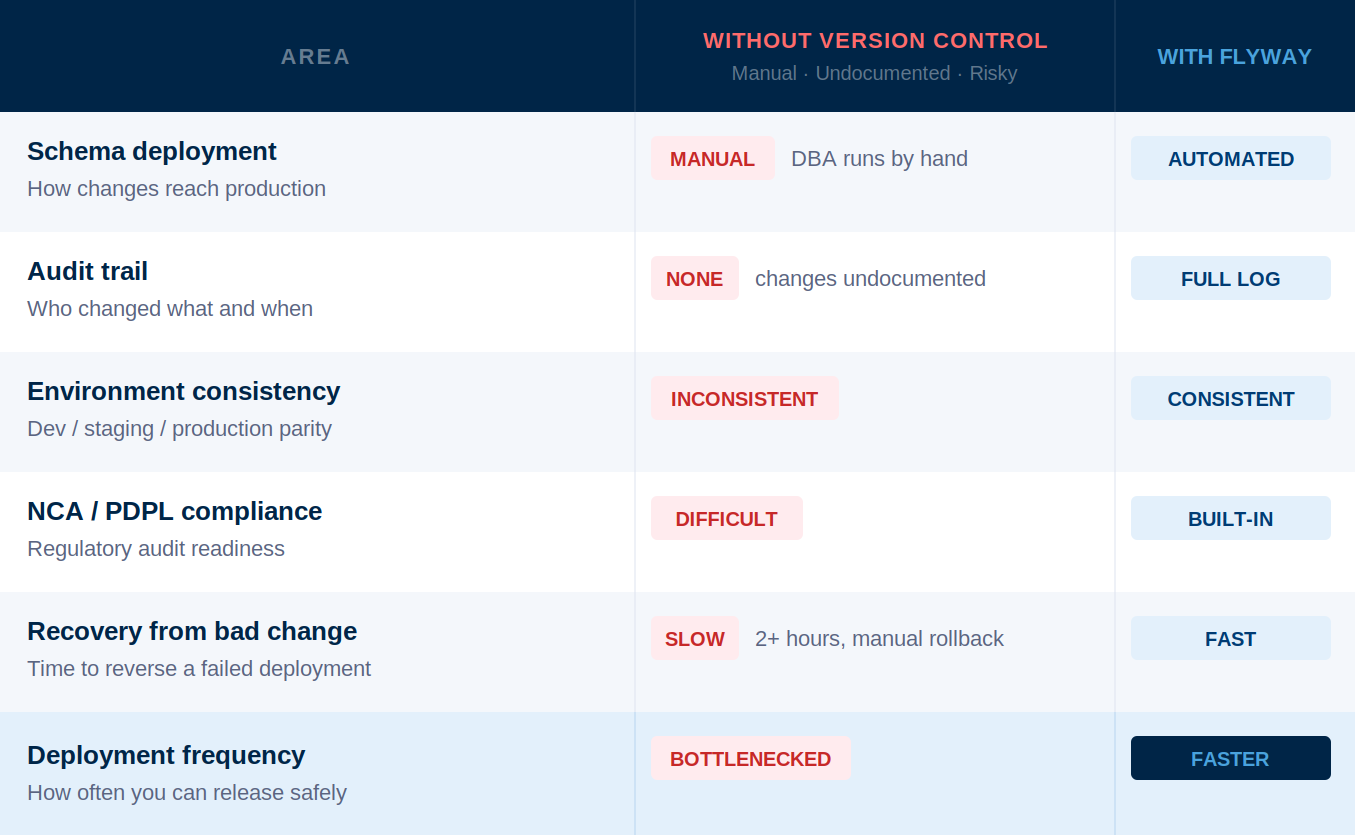
The pattern is structural, not statistical. Without version control, every one of these metrics is subject to someone's memory, someone's availability, and someone's willingness to document what they did. With it, none of them are.
How flyway closes the gap
Flyway, developed by Redgate, is the most widely adopted database migration tool in the world, used by over 800,000 users including 91% of the Fortune 100. It works with all major databases including SQL Server, Oracle, PostgreSQL, and MySQL, and integrates natively with every major CI/CD pipeline including Jenkins, Azure DevOps, GitHub Actions, and GitLab CI.
For KSA enterprises specifically, three things make Flyway worth looking at now rather than later.
Vision 2030 release pressure. Organizations across banking, government, and telecoms are under real pressure to ship software faster. Teams that still manage database changes manually are finding the database is the single biggest bottleneck in their delivery pipeline. Flyway removes it.
NCA ECC and PDPL audit requirements. Both regulatory frameworks require demonstrable audit trails of changes to data structures. Flyway's schema history table provides that trail automatically — without any additional documentation effort from the team.
Local talent dependency risk. Manual database processes depend on specific individuals who know how things were changed and in what order. When those individuals leave, that knowledge leaves with them. Version control puts it in the codebase, where it belongs.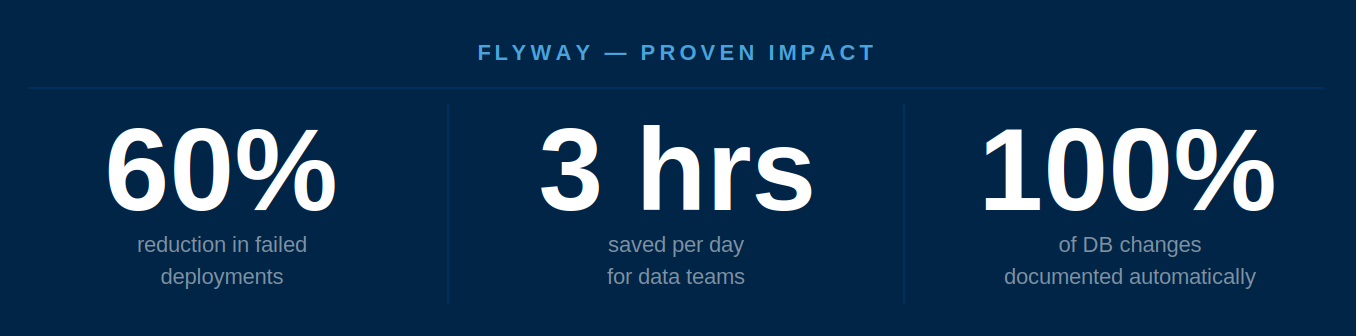
The right starting point
The good news is that adopting database version control does not require a complete overhaul of your existing systems. Flyway is designed to be introduced incrementally — you can start version-controlling new changes immediately, without having to retroactively document every historical migration. The tool takes a baseline snapshot of your current schema and tracks everything from that point forward.
Most teams are up and running within a day. Within a week, the change to daily workflow is minimal. Within a month, the improvement to release stability and team confidence is significant enough that going back is not a conversation anyone wants to have.
The teams that get this right stop treating database deployments as a separate, manual, person-dependent process and start treating them like the rest of their delivery pipeline — automated, audited, and boring in exactly the way production changes should be.
Acuative Middle East is the only Redgate partner with deep enterprise relationships across KSA's government, banking, and telecoms sectors. We deliver and support Flyway locally — with full Arabic-language onboarding and a team that understands your regulatory environment, your existing stack, and your delivery timelines.
The most expensive database strategy is the one where you wait for a failed deployment to prove you needed version control.
Ready to see Flyway in action?
Book a demo with our team and we'll show you exactly what database version control looks like inside your environment — no commitment required.
Contact Us