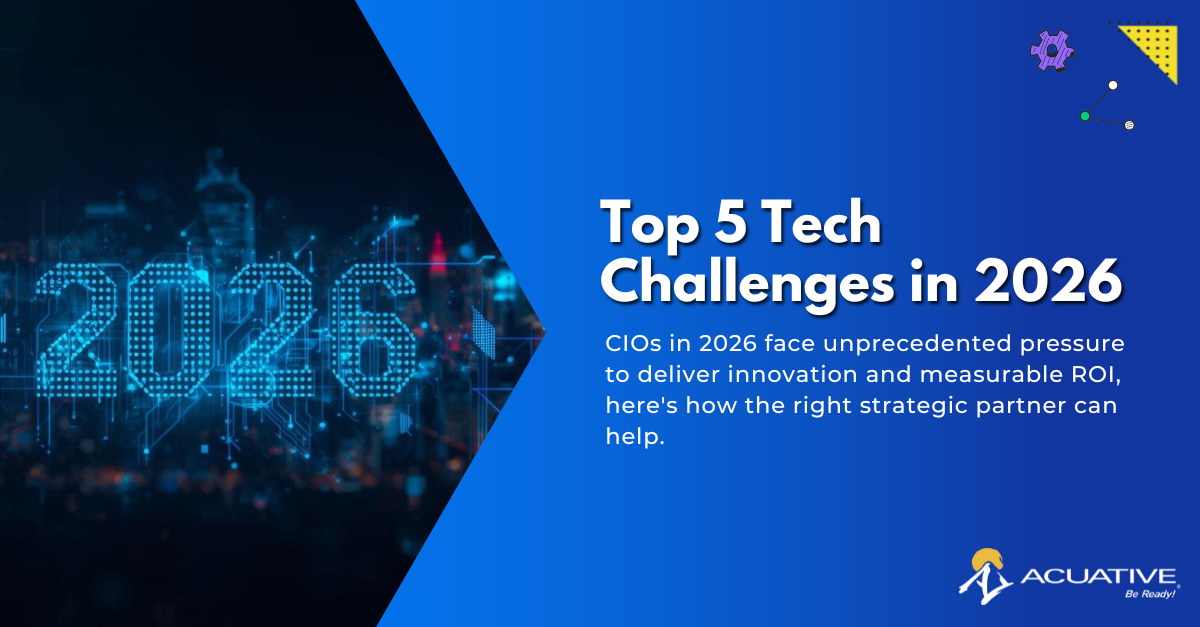
The role of the Chief Information Officer has fundamentally transformed. Nearly two-thirds of CIOs report that artificial intelligence has already redefined their responsibilities, pushing them beyond traditional IT management into strategic business leadership. As we move into 2026, CIOs face unprecedented pressure to deliver measurable business value while navigating talent shortages, security threats, and rapid technological change.
The question isn't whether CIOs need help: it's where that help should come from. Here are the five most pressing issues on CIO agendas and the various approaches organizations are taking to address them.
1. The AI Implementation Gap: Ambition Meets Reality
The Challenge: While 80% of government CIOs and the majority of enterprise leaders plan significant AI investments, expectations are shifting from aspirational transformation to pragmatic implementation. CIOs must deliver measurable business value from AI while establishing governance frameworks, managing risks, and reskilling their workforce. By 2026, 60% of Fortune 100 companies are expected to appoint dedicated heads of AI governance—but most organizations lack the internal expertise to implement AI safely and effectively.
Potential Approaches: Some organizations are building internal AI centers of excellence, hiring dedicated AI governance officers, and investing in extensive training programs. Others are partnering with AI consultancies for one-time implementations. However, many are discovering that external partners who provide ongoing AI risk assessments, data governance frameworks, and security policies offer a more sustainable path forward. The key advantage lies in accessing specialized expertise without the lengthy ramp-up time of building capabilities from scratch—particularly important when 87% of leading technology partners are actively investing in AI capabilities themselves.
2. Cybersecurity: The Never-Ending Arms Race
The Challenge: Cybersecurity remains the top investment priority across all organization types, with 85% of government CIOs increasing their budgets. The threat landscape now includes AI-enabled attacks like deepfakes and advanced phishing campaigns. Meanwhile, cyber insurance requirements are forcing organizations to demonstrate robust security frameworks including multi-factor authentication, air-gapped backups, and documented incident response capabilities. CIOs face board-level accountability for security posture—but struggle to find and retain the specialized talent needed to stay ahead of evolving threats.
Potential Approaches: Large enterprises often build dedicated security operations centers and hire full-time CISOs with specialized teams. Mid-market organizations might invest in comprehensive security platforms and train existing staff. Increasingly though, organizations are exploring fractional security leadership models that provide access to enterprise-grade expertise—including AI-powered SIEM, managed detection and response, and Zero Trust architecture—without the overhead of building entire departments. The consolidation benefit is significant too: organizations working with partners who can rationalize vendor sprawl often recapture 10-20% in margins while simultaneously reducing operational complexity.
3. The Talent Crisis: Innovation's Primary Inhibitor
The Challenge: Over half of CIOs cite talent shortages as their number one barrier to innovation. The rapid pace of technological change—particularly around AI, cloud architecture, and advanced security—has created a skills gap that traditional hiring cannot fill fast enough. CIOs must simultaneously reskill existing staff, compete for scarce specialized talent, and build organizational structures that enable human-AI collaboration. All of this while managing budget constraints and pressure to deliver immediate business results.
Potential Approaches: Organizations are attacking this from multiple angles: partnering with universities for talent pipelines, implementing aggressive reskilling programs, offering premium compensation packages, and building remote-first teams to access global talent pools. Yet the timeline challenges remain—hiring and training takes months while business needs are immediate. This reality is driving many CIOs toward flexible engagement models that provide on-demand access to specialized expertise across security, cloud, and AI domains. The data speaks to this shift: 48% of SMBs and 62% of enterprises now rely on external partners for cloud management specifically because it allows them to scale capabilities based on project needs without long-term commitments.
4. Cloud Complexity and Cost Optimization
The Challenge: Cloud modernization remains mission-critical, but CIOs must now balance complexity across public cloud, on-premise infrastructure, and edge computing environments. Cost optimization through FinOps practices has become central to cloud strategy—CIOs face intense pressure to maximize value from cloud investments while controlling sprawl. Over half of IT leaders plan budget increases for 2026, yet they operate under immense pressure to prove ROI on every dollar spent.
Potential Approaches: Some organizations are hiring dedicated FinOps teams and cloud architects to manage multi-cloud complexity internally. Others are consolidating onto single cloud platforms to reduce operational overhead. A third path involves delegating the operational complexity of hybrid and multi-cloud environments to specialists who can implement FinOps best practices, ensure compliance, and manage interoperability—freeing internal teams to focus on innovation rather than infrastructure management. The strategic question becomes: where does your organization add the most value—in cloud optimization mechanics or in leveraging cloud capabilities for business innovation?
5. Proving Business Value in a Results-Driven Era
The Challenge: CIOs are increasingly held directly accountable for delivering measurable business outcomes, not just managing technology effectively. The evaluation criteria have shifted from traditional IT metrics (uptime, ticket response times) to business impact measures (revenue enablement, process efficiency, innovation velocity). CIOs must shift from technology management to business strategy—demonstrating how IT investments drive competitive advantage and bottom-line results.
Potential Approaches: Progressive CIOs are rebuilding their reporting frameworks around business outcomes, investing in analytics platforms that connect IT initiatives to revenue and efficiency metrics, and restructuring their teams around business domains rather than technical functions. Some are bringing in strategy consultants to help reframe IT's value proposition. Others are finding that partners who already speak the language of business outcomes—quantifying "problems prevented" rather than "tickets handled," or "business continuity improvements" rather than "response time reductions"—can accelerate this transformation. The emergence of data-as-a-service offerings and industry benchmarking tools provides the strategic intelligence CIOs need without building entire analytics practices from scratch.
The Path Forward: Strategic Choices in a Transformative Era
The common thread across all five challenges is clear: CIOs need access to specialized expertise, the ability to scale capabilities quickly, measurable business outcomes, and partners who understand both technology and business strategy.
The solutions vary by organization size, industry, and maturity. Some will build everything in-house. Others will assemble a collection of point solutions and consultants. A growing number are discovering that strategic partners who can provide integrated capabilities across multiple domains—functioning less like vendors and more like extensions of the leadership team—offer the most efficient path forward.
For organizations exploring this latter approach, the key is finding partners who have evolved beyond reactive support into proactive strategic partnership. Those who combine deep technical expertise with business acumen, who invest heavily in emerging technologies like AI, and who measure success by your business outcomes rather than their activity metrics represent a fundamentally different value proposition.
The most transformative period in IT history demands equally transformative approaches to capability building. The organizations that thrive will be those whose CIOs make strategic choices about where to build, where to buy, and where to partner—ensuring their teams focus on what creates the most competitive advantage while accessing world-class expertise for everything else.
Ready to explore strategic IT partnership for your organization? Acuative specializes in helping CIOs navigate these exact challenges with business-aligned technology solutions, fractional expertise, and outcome-focused strategies. Let's discuss how we can support your 2026 priorities. Contact us today to schedule a strategic consultation.
About James McMenamin
Since 1998, James has been involved deeply in Technology deployments across the globe in clients large, small and all sizes in-between. As a Tech enthusiast, he not only recommends, but, is a hands-on user who uses many of the solutions recommended to clients. James's passion for Cybersecurity and how this applies to a business strategy aligns to his core belief that you are only as secure as the weakest link in your network internally or externally.