Satellite connectivity has moved from a last-resort option to a practical part of the enterprise network. Here is what changed, and why low Earth orbit is behind it.
For most of the satellite era, "satellite internet" carried a specific reputation in IT circles: available almost anywhere, but slow enough that real-time applications were off the table. That reputation was earned honestly. It was also built on a single class of satellite that no longer represents the whole market.
Low Earth orbit, or LEO, is the reason the conversation has changed. Understanding what LEO actually is — and what it is not — is increasingly relevant for any organization that operates distributed sites, remote facilities, or locations where terrestrial broadband is unreliable or simply unavailable.
Defining Low Earth Orbit (LEO)
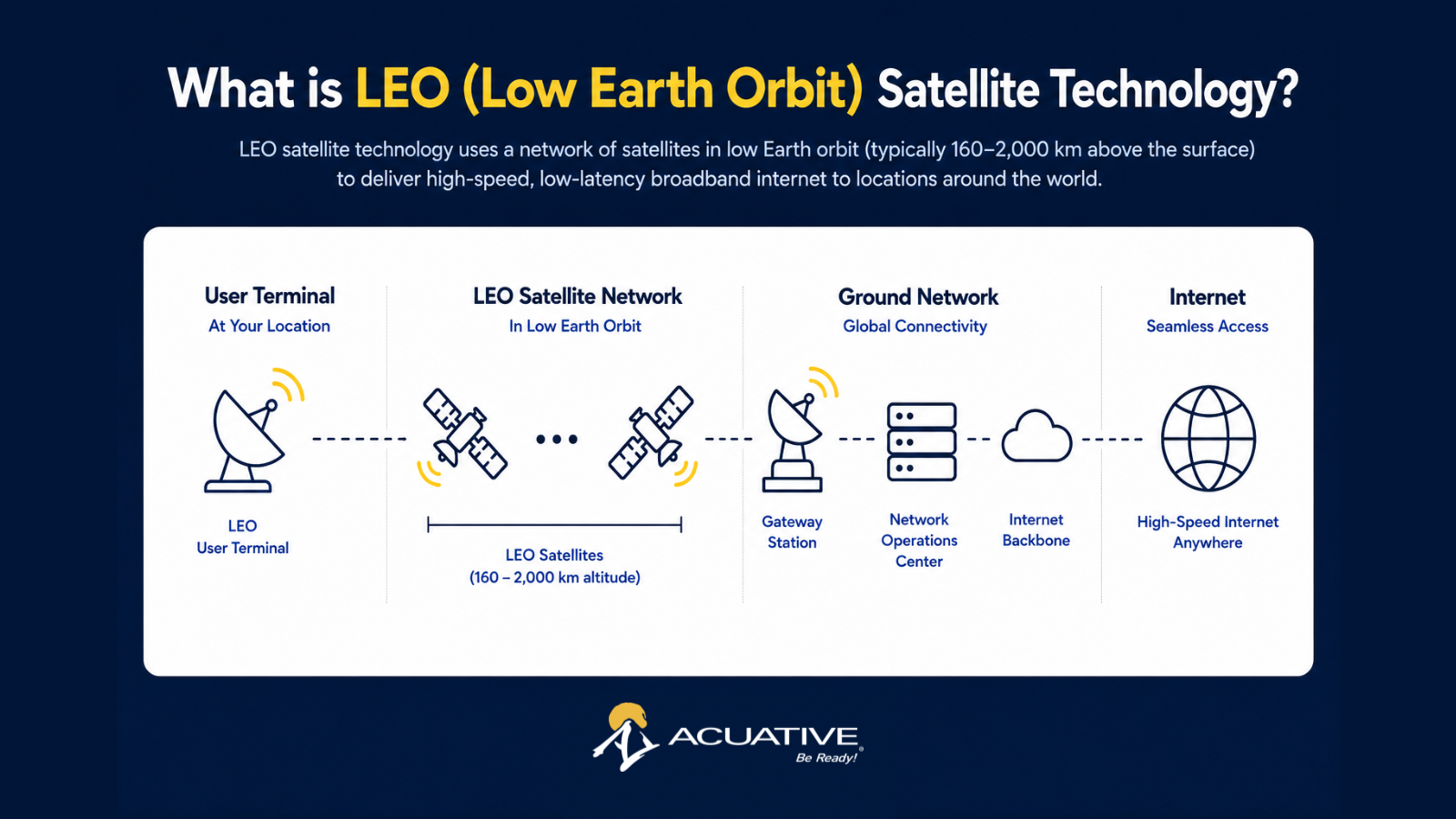
A low Earth orbit satellite is one that circles the planet at an altitude of roughly 160 to 2,000 kilometers (about 100 to 1,200 miles). For comparison, commercial aircraft cruise at about 11 kilometers. Starlink, the constellation most enterprises encounter today, operates a large portion of its fleet near 550 kilometers.
At that altitude, a satellite has to travel fast to stay in orbit — approximately 17,000 miles per hour, completing a full trip around the Earth roughly every 90 to 120 minutes. This produces the defining trait of LEO: no single satellite stays over your site for long. A given satellite is typically overhead for only a few minutes before it passes below the horizon.
That constraint explains almost everything else about how LEO systems are designed.
LEO, MEO, and GEO: The Practical Differences
Traditional satellite internet has historically relied on geostationary (GEO) satellites, which orbit at 35,786 kilometers. At that altitude, a satellite's orbital period matches the Earth's rotation, so it appears to hover over a fixed point. That is enormously convenient — a dish can be aimed once and left alone — but it comes at a cost. A signal has to travel roughly 72,000 kilometers round trip, and physics sets a hard floor on how quickly that can happen.
Orbit type | Typical altitude | Typical latency | Coverage characteristics |
|---|---|---|---|
LEO | 160–2,000 km (Starlink operates near 550 km) | Roughly 20–50 ms round trip in practice | Small footprint per satellite; requires a large constellation and continuous handoffs |
MEO | Approximately 2,000–35,000 km | Roughly 100–150 ms round trip | Broader footprint; commonly used for navigation systems such as GPS |
GEO | 35,786 km | Roughly 500–600 ms round trip | Three satellites can cover most of the globe; fixed position above the equator |
Figures are representative and vary by constellation, ground infrastructure, and network conditions.
The latency difference is not a marginal improvement. Half a second of delay makes voice calls awkward, video conferencing unusable, and interactive applications — VPN sessions, virtual desktops, cloud POS, SCADA polling — frustrating at best. Bringing round-trip delay down to the tens of milliseconds puts satellite links within range of the same applications an organization runs over fiber or 5G.
Why LEO Requires a Constellation
A GEO satellite sees roughly a third of the planet. A LEO satellite, sitting far closer to the surface, sees a much smaller area — and it is moving through that area constantly. Delivering continuous service therefore requires two things: a large number of satellites in coordinated orbital planes, and a terminal capable of tracking and handing off between them without interrupting the session.
This is the engineering shift that made LEO viable commercially. Launch costs fell far enough to make constellations of thousands of satellites practical, and phased-array antennas replaced mechanically steered dishes with electronically steered beams that can switch satellites in milliseconds. The user-side terminal does the tracking automatically; the site simply needs an unobstructed view of the sky.
What LEO Changes for Enterprise Networks
For a distributed organization, LEO is less a novelty than a new option in the WAN design toolkit. Its practical value falls into four areas.
Coverage where terrestrial options do not reach
Remote field sites, construction and energy operations, rural clinics, agricultural facilities, and pop-up locations frequently sit outside the footprint of business-grade fiber or cable. LEO does not care about trenching distance or last-mile economics.
Genuine path diversity
Two terrestrial circuits at the same site often share a conduit, a pole line, or a central office. A satellite link is physically independent of that infrastructure, which makes it meaningful redundancy rather than nominal redundancy — particularly during regional outages, storms, and fiber cuts.
Speed of deployment
Provisioning a terrestrial circuit at a new location can take weeks or months. A satellite terminal can be installed and online in a fraction of that time, which matters for acquisitions, seasonal sites, disaster recovery, and temporary operations.
Load balancing, not just failover
Modern hybrid designs can distribute traffic across cellular and satellite paths rather than holding the satellite link idle as a spare. Done well, that turns a backup expense into usable capacity.
The Honest Limitations
LEO is a strong tool, not a universal answer, and any credible evaluation should account for its constraints.
- Line of sight is mandatory. A satellite terminal needs a clear, unobstructed view of the sky. Dense urban environments, tree cover, and certain rooftop conditions require site survey work before commitment.
- Weather has an effect. Heavy rain and snow can degrade throughput, and accumulation on the terminal itself can interrupt service if not managed.
- Capacity is contended. Bandwidth is shared among users within a given service area. Performance can vary with local subscriber density.
It is not identical to fiber. Latency is dramatically better than GEO but generally still higher than a well-provisioned fiber circuit. Latency-critical trading or industrial control applications warrant specific evaluation.
Most enterprises get the best result by treating LEO as one path within a managed, multi-transport design — not as a wholesale replacement for the WAN.
Bring LEO into Your Network with Acuative
Acuative delivers LEO connectivity as part of a fully managed service through our partnership with T-Mobile for Business and the launch of SuperBroadband — a hybrid solution that integrates T-Mobile's nationwide 5G network with Starlink low Earth orbit satellite connectivity in a single managed offering.
Paired with AcuConnect, this gives your organization one accountable partner across design, installation, configuration, and 24/7 NOC monitoring — with automatic satellite failover and load balancing built in, and coverage that extends to locations traditional broadband cannot reach. One provider. One contract. One number to call when something needs attention.
Talk to Acuative about extending resilient connectivity to every one of your sites, or learn more about T-Mobile SuperBroadband.