Which is Higher?
It's the question every budget owner eventually asks out loud: "Is this observability platform actually worth what we pay for it?" The honest answer only becomes obvious when you put it next to the thing it's designed to prevent — the cost of going dark.
Observability has a price tag you can read on an invoice. Downtime has a price tag too, but it hides — split across lost revenue, idle engineers, missed SLAs, and customers who quietly don't come back. When you finally total both columns, the comparison stops being close. The purpose of this piece is to make that total visible before an outage forces the calculation.
Observability is a bill you choose. Downtime is a bill you receive.
// THE WHOLE ARGUMENT, IN ONE LINE
What downtime actually costs?
The headline number everyone quotes "X dollars per minute" is only the surface. Real outage cost stacks up across at least five layers, and most organizations only ever measure the first one.
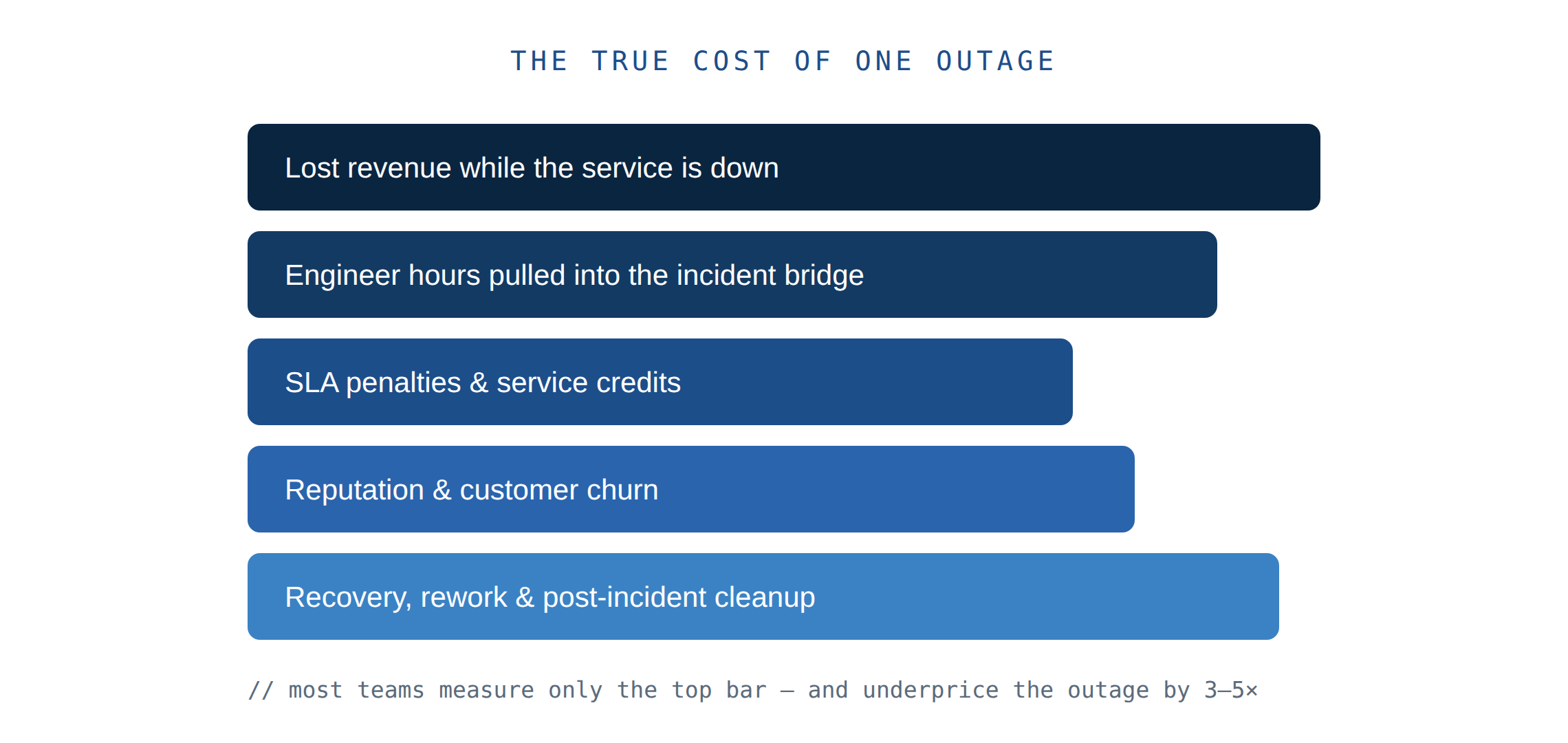
Here's why the iceberg matters: the layers you don't measure are often larger than the one you do. A 90-minute outage might cost a few thousand in direct revenue — and then quietly cost ten times that in churned enterprise accounts, blown SLA credits, and a week of engineers cleaning up instead of shipping.
What observability actually costs & returns
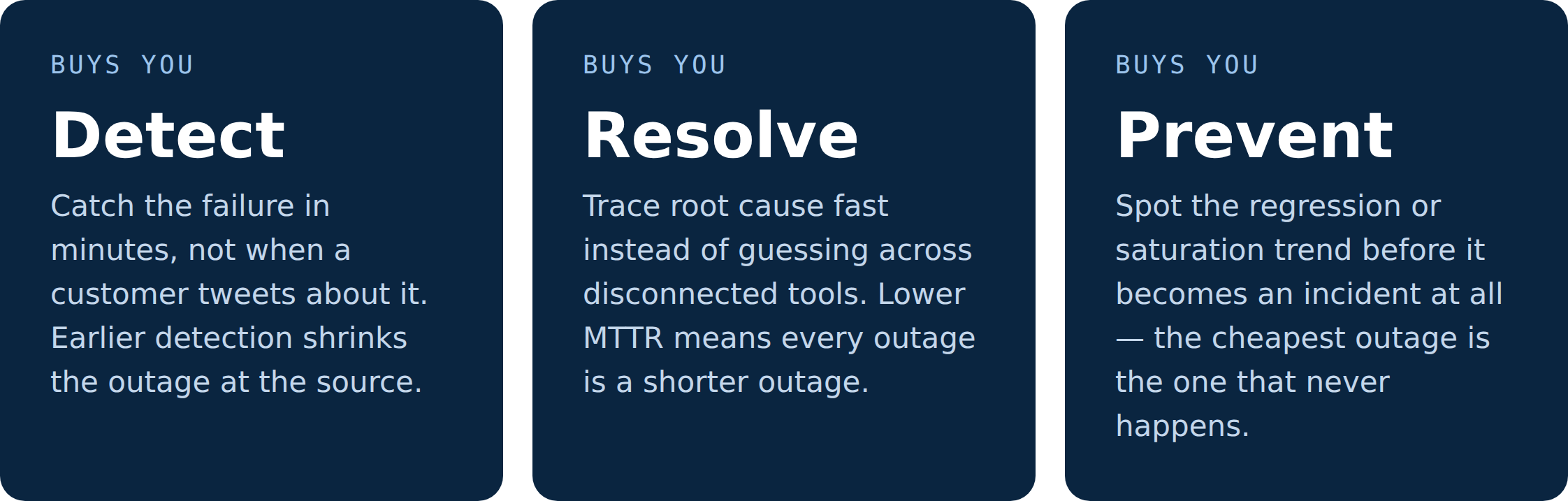
Observability's cost is refreshingly boring: platform fees, data ingestion, and the engineering time to run it. It's a known, fixed, plannable number. What it buys is the thing that shrinks every layer in the downtime column at once.
That's the asymmetry at the heart of this comparison. Observability spend is linear and predictable. Downtime cost is spiky and uncapped — one bad incident can dwarf a year of platform fees. You're effectively trading a steady, controllable expense for protection against a volatile, uncontrollable one.
You don't buy observability to watch dashboards. You buy it to make
every outage shorter, rarer, and cheaper.
// WHAT THE INVOICE ACTUALLY PROTECTS
Putting the two columns next to each other
This is where the question answers itself. You don't need exact figures to see it — line up the two columns by direction of travel and the pattern is unmistakable. Every operational metric that drives outage cost moves the right way once observability is in place.
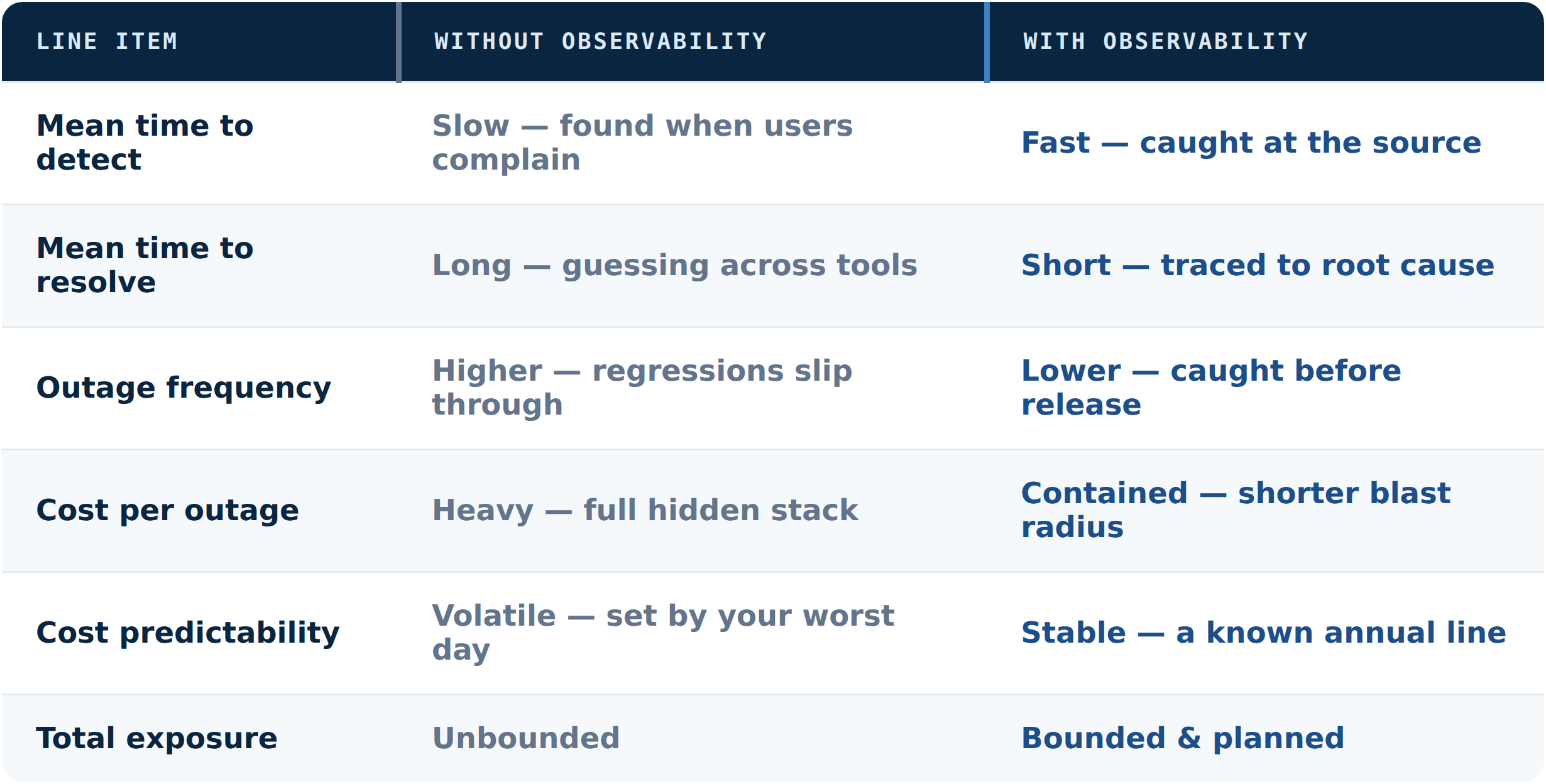
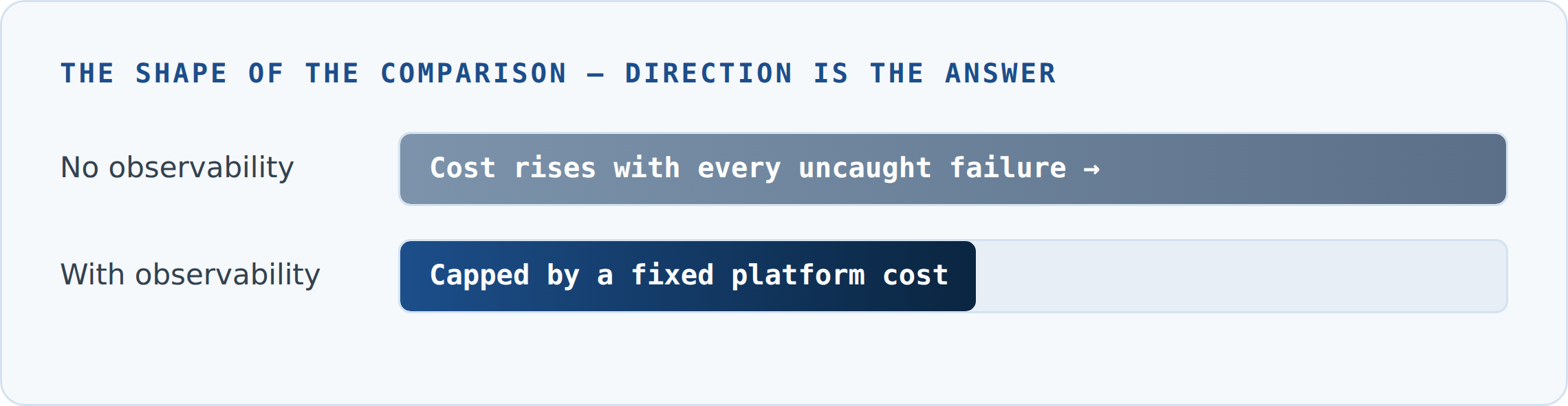
The exact dollars depend on your service, your traffic, and your tolerance for risk — but the shape never changes. One column grows without a ceiling; the other is set once and held steady. Whatever your numbers turn out to be, observability shifts cost from the unpredictable side of the ledger to the side you control.
The comparison you can run yourself
You don't need a model. Four inputs you already have produce a defensible figure.
| Cost per hour of downtime Revenue per hour for the affected service, plus the loaded cost of everyone pulled into the incident. This is your multiplier. |
| Hours of downtime per year Outages × average duration, pulled straight from last year's incident log. Be honest — include the slow-burn degradations too. |
| Expected reduction Apply a conservative reduction in detection and resolution time. Even a 40–60% cut is well within what teams report after consolidating observability. |
| Subtract the platform cost Take the downtime avoided and subtract the all-in observability spend. What's left is your net annual return — usually a large positive number. |
So — which is higher?
For almost any organization running a service that customers depend on, the cost of downtime is higher, and it isn't close. The reason is structural: observability is a bounded cost you set once a year, while downtime is an unbounded cost set by your worst day. You can budget for the first. You cannot budget for the second.
The teams that get this right stop framing observability as an expense to justify and start framing it as insurance with a measurable payout. The premium is the platform bill. The claim is every outage that ended in minutes instead of hours — or never happened at all.
The most expensive observability strategy is the one where you wait for the outage to prove you needed it.
The right starting point
The organizations that keep outage costs lowest are not necessarily the ones with the biggest budgets or the deepest in-house teams. They are the ones that have removed the operational friction between a signal and a fix — and have someone actively watching the platform that makes early detection possible. A best-in-class observability stack still costs you full-length outages if no one is tuning the alerts, scaling the pipeline, or answering the page at 2 a.m.
That's the gap a managed service closes. Acuative Managed Service delivers enterprise-grade observability that is actively managed and monitored around the clock — so detection is fast, resolution is short, and the cost column that grows without a ceiling never gets the chance to. It's available regardless of where you're starting from, how many licenses you need at the outset, or what tools you're running today.
Ready to see Acuative Managed Service in action?
Request a 30-day free Proof of Concept — no hardware, no minimum licenses, no commitment. Our team will configure a live, fully managed environment for your specific use case within days, so you can measure the downtime-vs-observability gap on your own stack instead of estimating it.
Contact Us