Peter Kolodgy
Broadband connectivity underpins virtually every modern business function from cloud-hosted applications and VoIP phone systems to point-of-sale terminals and real-time data transfer. Yet despite its critical role, many organizations treat broadband as a commodity purchase rather than a strategic infrastructure decision. Understanding what broadband actually is, how it's delivered, and what differentiates a business-grade connection from a consumer one is essential to making the right choice for your network.
What Is Broadband?
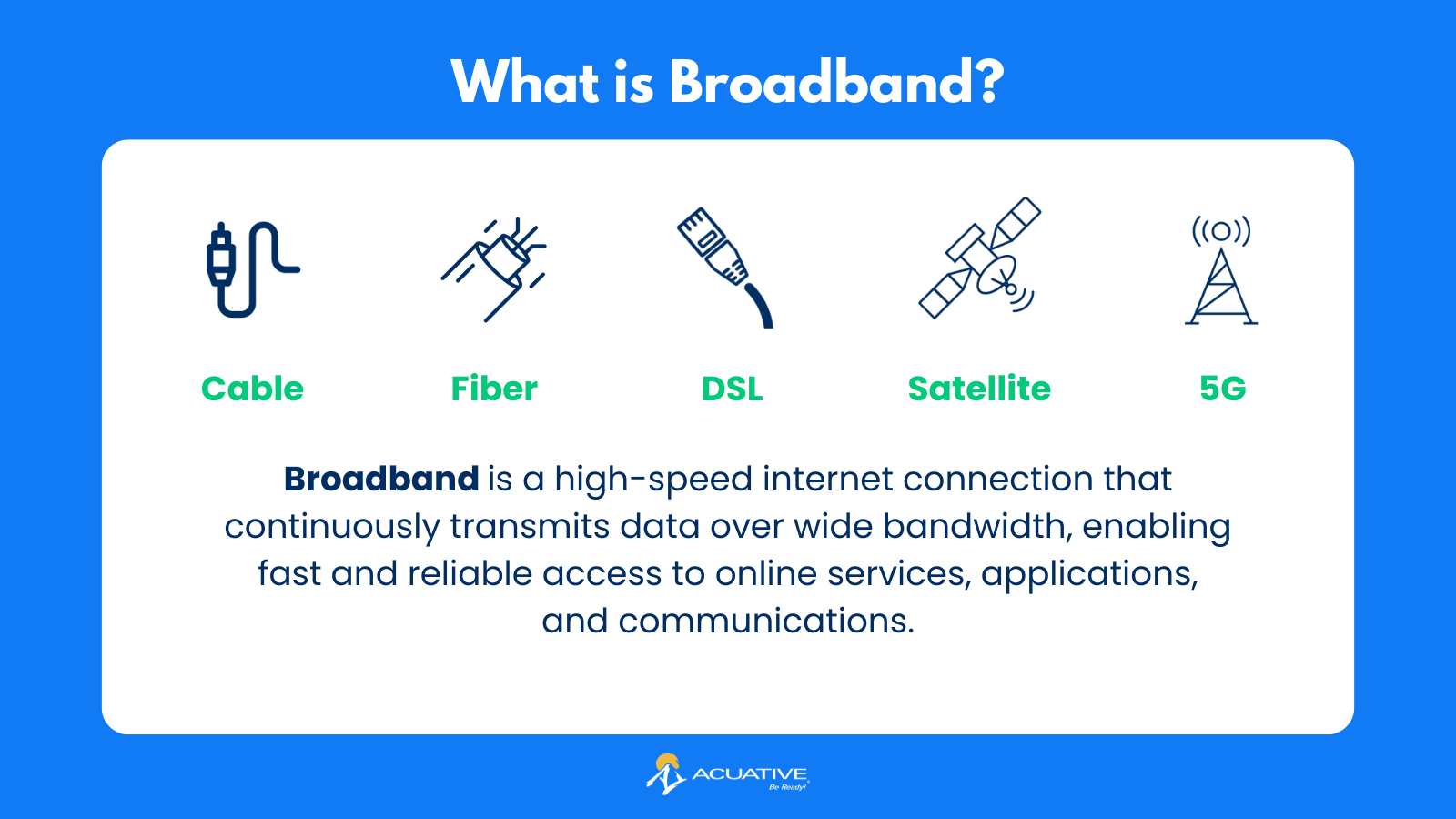
Broadband refers to high-speed internet access that is always on and faster than traditional dial-up connections. The term itself, 'broad bandwidth,' describes the wide range of frequencies used to transmit data simultaneously, enabling fast, reliable communication across the internet.
The Federal Communications Commission (FCC) defines broadband as internet access with download speeds of at least 25 Mbps and upload speeds of at least 3 Mbps, though modern business applications increasingly demand far greater throughput.
| Did You Know? The FCC recently updated its broadband speed benchmark to 100 Mbps download/20 Mbps upload for fixed internet access, reflecting the growing demands of video conferencing, cloud computing, and real-time collaboration tools. |
How Does Broadband Work?
Broadband works by transmitting data across a physical or wireless medium using a wide range of radio or electrical frequencies. Unlike dial-up, which used a narrow frequency band and blocked phone lines during use, broadband connections are always available and can carry significantly more data at once.
The most common broadband delivery technologies include:
- Fiber Optic: Transmits data as pulses of light through glass or plastic cables. Offers the highest speeds and lowest latency, making it ideal for enterprise use.
- Cable: Delivers internet via the same coaxial infrastructure used for cable TV. Widely available with strong download speeds.
- DSL (Digital Subscriber Line): Uses existing telephone lines. More limited in speed but available in many rural and suburban areas.
- Satellite: Uses orbiting satellites to deliver internet. Increasingly capable with low-earth orbit (LEO) satellite networks improving latency.
- Fixed Wireless: Transmits data via radio signals to a receiver at your location. A viable option where wired infrastructure is limited.
Why Does Broadband Speed Matter?
Speed is one of the most critical factors in evaluating a broadband connection. Bandwidth, measured in megabits per second (Mbps) or gigabits per second (Gbps), determines how much data can travel between your network and the internet at any given time.
For businesses, insufficient bandwidth leads to dropped video calls, slow cloud application performance, frustrated employees, and degraded customer experiences. As organizations scale and adopt more SaaS tools, VoIP systems, and cloud-based infrastructure, broadband requirements grow accordingly.
| Key Terms to Know Download Speed: How fast data moves from the internet to your device. Upload Speed: How fast data moves from your device to the internet. Latency: The delay between a request and a response, measured in milliseconds Bandwidth: The maximum data transfer capacity of your connection. |
Types of Broadband Connections for Businesses
Not all broadband is created equal. Businesses need to evaluate several factors including speed, reliability, redundancy, and service-level agreements (SLAs) when selecting a connectivity solution.
- Dedicated Internet Access (DIA): A connection with bandwidth reserved exclusively for your business, providing consistent speeds and strong SLAs. Ideal for mission-critical operations.
- Business Cable or Fiber: Shared infrastructure with business-grade support tiers. A cost-effective solution for many small and mid-sized organizations.
- SD-WAN with Broadband: Software-defined WAN technology can aggregate multiple broadband connections, intelligently routing traffic for optimal performance and built-in redundancy.
- 4G/5G Cellular Broadband: Wireless connectivity via mobile networks. Excellent for failover, temporary sites, or locations without wired access.
Broadband vs. Other Connectivity Options
It is worth distinguishing broadband from other enterprise connectivity technologies:
- MPLS (Multiprotocol Label Switching): A private network routing method that offers high reliability and QoS, but at a premium cost. Often supplemented or replaced with broadband + SD-WAN for cost savings.
- Leased Lines: Dedicated point-to-point circuits with guaranteed bandwidth. Very reliable but expensive and inflexible compared to modern broadband alternatives.
- Ethernet over Copper/Fiber (EoC/EoF): Metro Ethernet services that deliver scalable, low-latency connectivity for businesses in urban and suburban markets.
For many enterprises, the modern answer is a hybrid approach: combining broadband with SD-WAN to achieve both cost efficiency and enterprise-grade reliability.
What to Look for in a Business Broadband Provider
Choosing the right broadband provider is about far more than advertised speeds. Here are the key criteria businesses should evaluate:
- Reliability and Uptime SLAs: Look for providers offering 99.9%+ uptime guarantees backed by contractual obligations.
- Symmetrical Speeds: Businesses uploading large files, hosting VoIP, or running cloud applications benefit greatly from equal upload and download speeds.
- Scalability: Your connectivity needs will grow. Ensure your provider can scale bandwidth as your business expands.
- Support and Managed Services: Responsive technical support and proactive network monitoring can mean the difference between minutes and hours of downtime.
- Redundancy Options: Single points of failure are business risks. A provider that supports failover and diverse routing paths strengthens your resilience.
- Security Features: Built-in DDoS protection, firewall services, and encrypted tunneling add critical layers of protection.
Frequently Asked Questions (FAQ)
Q: What is the difference between broadband and Wi-Fi?
A: Broadband refers to your internet connection itself — the pipeline of data coming into your building from an internet service provider. Wi-Fi is the wireless technology that distributes that connection within your space. You can have fast broadband and still experience poor Wi-Fi performance if your internal network is poorly configured, and vice versa.
Q: Is broadband the same as fiber internet?
A: No. Fiber is one type of broadband delivery technology. Broadband is the broader category that includes fiber, cable, DSL, fixed wireless, and satellite. Fiber happens to be the highest-performing broadband medium currently available, but not all broadband is fiber.
Q: How much broadband speed does a business actually need?
A: A general rule of thumb is 25 Mbps per employee for standard office use, but businesses running VoIP, video conferencing, large file transfers, or cloud-heavy workflows should budget significantly more. A 50-person office using Microsoft Teams, cloud ERP, and VoIP simultaneously could require 500 Mbps to 1 Gbps to operate without congestion.
Q: What does broadband latency mean and why does it matter?
A: Latency is the time it takes for a data packet to travel from your device to a destination server and back, measured in milliseconds. Low latency is critical for real-time applications like VoIP calls, video conferencing, and financial transactions. A connection can have high bandwidth but high latency — both metrics matter independently.
Q: Can a business use residential broadband instead of a business plan?
A: Technically yes, but it comes with significant trade-offs. Residential broadband typically lacks service-level agreements (SLAs), offers limited upload speeds, provides no guaranteed uptime, and deprioritizes traffic during peak hours. For any organization that depends on connectivity to serve customers or run operations, business-grade broadband is the appropriate choice.
Q: What is broadband redundancy and does my business need it?
A: Broadband redundancy means having a secondary internet connection that activates automatically if your primary connection fails. For businesses where downtime has a direct cost — retail, healthcare, financial services, logistics — redundancy is not optional. It is increasingly standard practice to pair a primary fiber or cable connection with a 4G/5G failover circuit.
Q: How is broadband different from a leased line?
A: A leased line is a dedicated, point-to-point circuit with bandwidth reserved exclusively for one customer, typically backed by strong SLAs and symmetrical speeds. Broadband, by contrast, often uses shared infrastructure, meaning speeds can vary based on network demand. Leased lines cost more but offer predictable performance. Many businesses now achieve a similar outcome using dedicated internet access (DIA) or SD-WAN over broadband at a lower price point.
Q: What does 'symmetrical broadband' mean?
A: Symmetrical broadband means your upload speed matches your download speed. Most consumer and some business broadband plans are asymmetrical — offering much faster downloads than uploads. Symmetrical connections are important for businesses that regularly upload large files, host servers, use cloud-based backups, or rely heavily on video conferencing.
The Future of Broadband
Broadband technology continues to evolve rapidly. Multi-gigabit fiber is becoming more accessible, 5G Fixed Wireless Access (FWA) is expanding broadband to underserved areas, and low-earth orbit satellite constellations are transforming connectivity in remote regions.
For businesses, this evolution means more options, better performance, and new opportunities to build resilient, cost-effective network architectures. Organizations that invest in understanding and optimizing their broadband strategy today will be well-positioned for the demands of tomorrow.
Ready to connect your business? Acuative specializes in delivering reliable, enterprise-grade broadband solutions tailored to your organization's needs — from site assessments to ongoing network management. Learn how Acuative can design, deploy, and manage your broadband connectivity.
About Peter Kolodgy
With over four decades of successful business experience and more than $1 billion in goods and services sold across every continent, Peter Kolodgy brings a wealth of knowledge and expertise to Acuative’s Business Development team. A Cleveland, Ohio native, Peter has earned two college degrees and built a career driven by a passion for connecting businesses with innovative solutions. His global perspective and proven track record make him an invaluable asset in helping clients navigate the evolving world of network services and technology.