

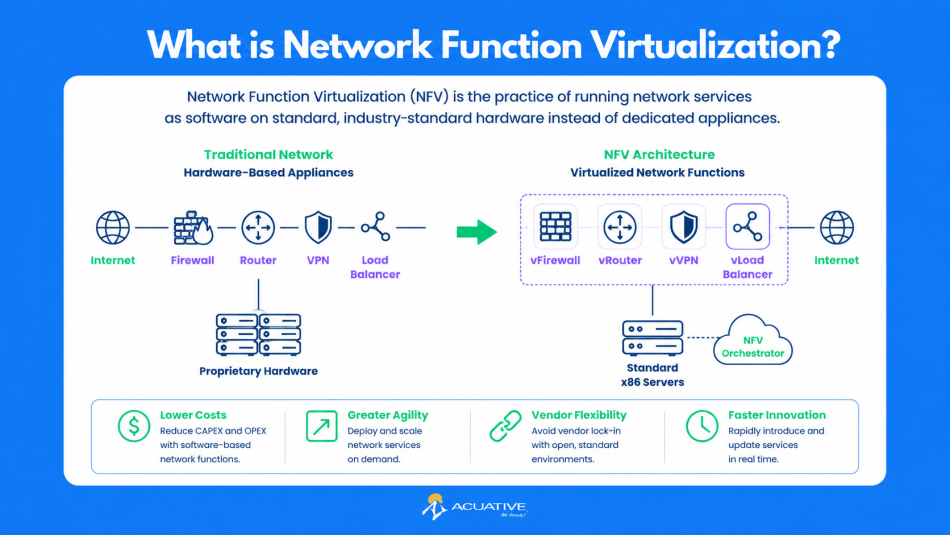
Traditional network infrastructure relies on dedicated hardware appliances to deliver critical network services such as firewalls, routers, load balancers, and WAN optimization. While these hardware-based solutions have powered enterprise networks for decades, they can be costly to scale, time-consuming to deploy, and difficult to manage across distributed environments.
Network Function Virtualization (NFV) is a technology that transforms how organizations build and manage networks by replacing specialized hardware appliances with software-based network functions that run on standard computing infrastructure.
By virtualizing network services, businesses can improve agility, reduce infrastructure costs, accelerate deployments, and create more flexible network environments that support modern technologies such as cloud computing, edge computing, 5G, and software-defined networking (SDN).
What Is Network Function Virtualization (NFV)?
Network Function Virtualization (NFV) is a network architecture approach that uses virtualization technology to run network services as software applications on commercial off-the-shelf (COTS) hardware instead of requiring dedicated physical appliances.
Rather than deploying separate hardware devices for every network function, organizations can deploy Virtual Network Functions (VNFs) that operate within virtual machines or containers hosted on standard servers.
Examples of network functions that can be virtualized include:
- Virtual firewalls
- Virtual routers
- Virtual load balancers
- Virtual WAN optimization
- Virtual intrusion prevention systems (IPS)
- Virtual network monitoring tools
- Virtual private network (VPN) gateways
NFV allows network services to be deployed, managed, and scaled through software, providing enterprises with greater flexibility and operational efficiency.
How Does Network Function Virtualization Work?
NFV separates network functions from proprietary hardware by using virtualization layers to deliver network services as software.
A typical NFV environment consists of three primary components:
1. Virtual Network Functions (VNFs)
VNFs are software-based versions of traditional network appliances.
For example, instead of installing a physical firewall at every branch location, an organization can deploy a virtual firewall that runs on a centralized server or cloud platform.
VNFs allow organizations to:
- Deploy services faster
- Scale resources up or down as needed
- Automate network operations
- Reduce dependence on specialized hardware
2. NFV Infrastructure (NFVI)
The NFV Infrastructure provides the underlying computing, storage, and networking resources required to run VNFs.
NFVI typically includes:
- Standard servers
- Virtualization software
- Storage systems
- Networking components
- Cloud infrastructure
Because NFV uses standard hardware, organizations are not locked into proprietary appliances from a single vendor.
3. NFV Management and Orchestration (MANO)
NFV Management and Orchestration (MANO) manages the deployment, configuration, and lifecycle of virtual network functions.
NFV MANO enables:
- Automated provisioning
- Resource allocation
- Performance monitoring
- Service scaling
- Policy management
This automation helps IT teams manage complex network environments more efficiently.
NFV vs Traditional Network Infrastructure
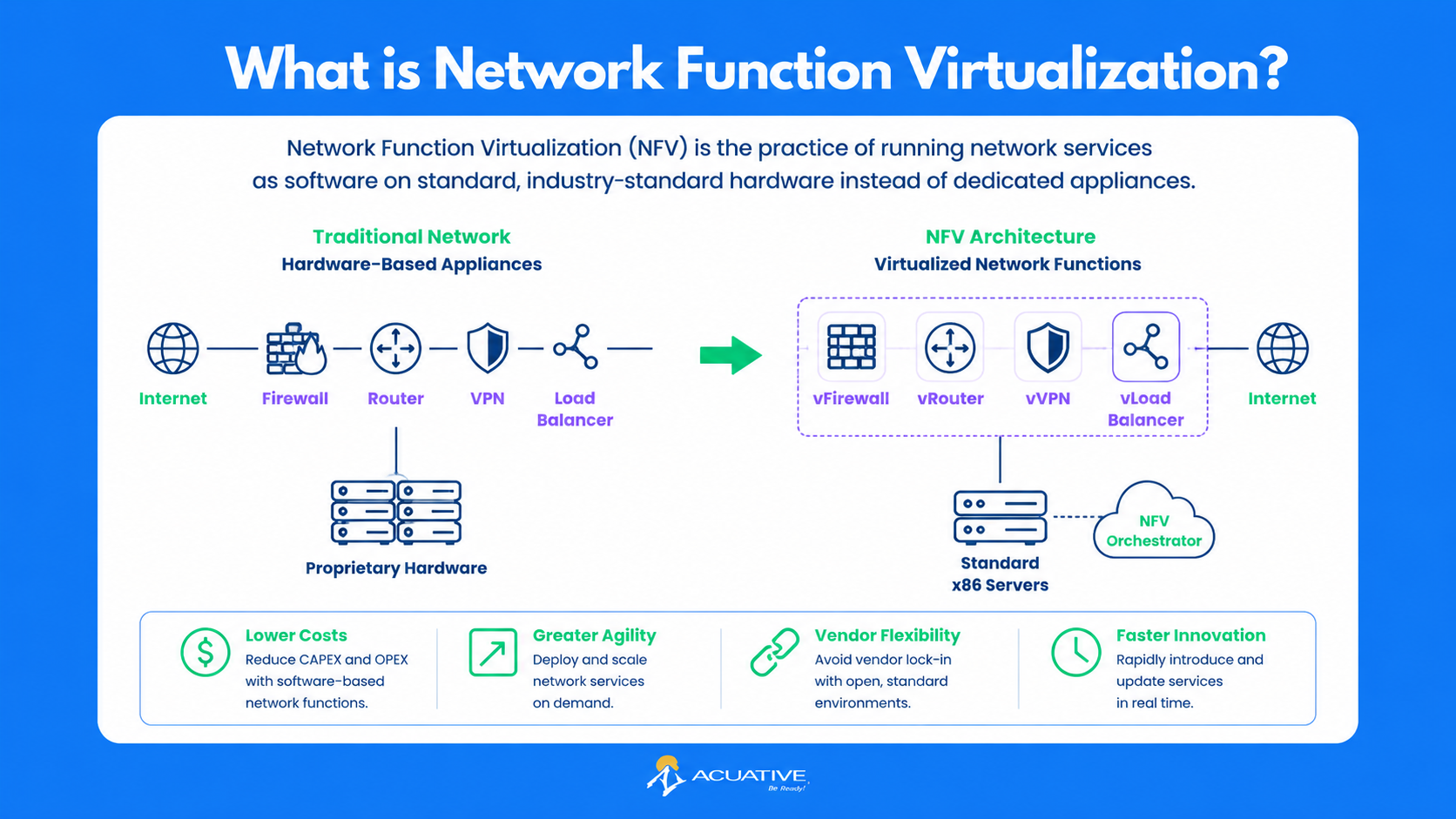
Traditional networks depend heavily on physical appliances, where each service requires dedicated hardware.
For example:
Traditional approach:
Internet → Physical Firewall → Physical Router → Physical Load Balancer → Application
NFV approach:
Internet → Virtualized Network Functions Running on Standard Infrastructure
The NFV model provides a more flexible approach because network services can be deployed through software rather than waiting for hardware installation and configuration.
What Are the Benefits of Network Function Virtualization?
1. Reduced Hardware Costs
NFV reduces the need to purchase, install, and maintain specialized networking appliances. Organizations can run multiple network functions on shared infrastructure, lowering capital and operational expenses.
2. Faster Network Deployment
Because network functions are software-based, new services can be deployed much faster than traditional hardware installations.
Businesses can quickly introduce:
- New security services
- Additional network capacity
- Branch connectivity solutions
- Cloud-based networking capabilities
3. Improved Scalability
NFV allows organizations to scale network services based on demand.
For example, a business experiencing seasonal traffic increases can allocate additional virtual resources without purchasing additional hardware.
4. Greater Network Flexibility
NFV enables organizations to adapt their networks more easily by allowing network functions to be moved, updated, or modified through software.
This flexibility supports:
- Hybrid cloud environments
- Remote offices
- Multi-location enterprises
- Digital transformation initiatives
5. Increased Automation
NFV works alongside automation and orchestration tools to simplify network management.
Automated provisioning and monitoring can help IT teams:
- Reduce manual configuration
- Minimize errors
- Improve service availability
- Respond faster to network changes
How NFV Works With SD-WAN
NFV and Software-Defined Wide Area Networking (SD-WAN) are often used together to modernize enterprise networks.
While SD-WAN focuses on intelligently managing connectivity across locations, NFV provides the ability to deliver network services virtually.
Together, they enable organizations to deploy virtualized services such as:
- Virtual firewalls
- Security gateways
- WAN optimization tools
- Routing functions
This combination helps enterprises create more agile, secure, and scalable wide area networks.
NFV vs SDN: What Is the Difference?
Although NFV and Software-Defined Networking (SDN) are closely related, they solve different challenges.
| Technology | Purpose |
|---|---|
| Network Function Virtualization (NFV) | Virtualizes network services and replaces hardware appliances with software |
| Software-Defined Networking (SDN) | Separates network control functions from physical networking equipment to enable centralized management |
NFV focuses on what network functions run, while SDN focuses on how network traffic is managed and controlled.
Many modern enterprise networks use both technologies together to improve automation, flexibility, and performance.
Common Use Cases for NFV
Enterprise Branch Networking
Organizations with many locations can deploy virtual network services across branches without installing dedicated hardware at each site.
Managed Network Services
Managed service providers use NFV to deliver scalable networking solutions, including virtual routers, security services, and WAN solutions.
5G Networks
Telecommunications providers use NFV to support 5G capabilities by enabling flexible network architectures and network slicing.
Cloud Connectivity
NFV allows organizations to deploy network services closer to cloud environments, improving connectivity and performance.
Security Services
Virtualized security functions allow businesses to deploy protection capabilities faster and adapt security policies dynamically.
Challenges of Network Function Virtualization
While NFV provides many advantages, organizations should consider several challenges:
Infrastructure Requirements
NFV requires sufficient computing, storage, and networking resources to support virtualized workloads.
Management Complexity
Managing virtualized network functions across multiple environments may require advanced orchestration and monitoring tools.
Performance Considerations
Some high-performance workloads may require careful resource allocation to maintain expected network performance.
Security Management
Virtualized environments require strong security practices to protect software-based network functions and underlying infrastructure.
The Future of Network Function Virtualization
As enterprises continue adopting cloud-based networking, automation, and edge computing, NFV will remain an important technology for building flexible network environments.
NFV is especially valuable as organizations adopt:
- 5G connectivity
- Edge computing
- Cloud-native applications
- Zero Trust security models
- Automated network operations
By moving network services from dedicated hardware to software, NFV helps organizations create networks that are easier to manage, scale, and adapt.
Frequently Asked Questions About Network Function Virtualization
What does NFV stand for?
NFV stands for Network Function Virtualization. It is a technology that converts traditional hardware-based network services into software-based virtual network functions.
What is an example of NFV?
An example of NFV is replacing a physical firewall appliance with a virtual firewall that runs as software on standard server infrastructure.
What is the difference between NFV and SD-WAN?
NFV virtualizes network services, while SD-WAN manages and optimizes network connectivity between locations. The two technologies are often combined to create more flexible enterprise networks.
Is NFV the same as virtualization?
NFV uses virtualization technology, but they are not the same. Virtualization creates virtual versions of computing resources, while NFV specifically applies virtualization to network services.
What are Virtual Network Functions (VNFs)?
Virtual Network Functions (VNFs) are software-based versions of network services that traditionally required dedicated hardware, such as routers, firewalls, and load balancers.
What are the benefits of NFV for businesses?
NFV helps businesses reduce hardware costs, deploy network services faster, improve scalability, increase automation, and create more flexible IT environments.
Does NFV replace physical networking hardware?
NFV does not completely eliminate physical networking hardware. Instead, it reduces reliance on specialized appliances by allowing many network functions to run as software on standard infrastructure.
Modernize Your Network With Flexible, Software-Driven Solutions
As businesses face increasingly complex network environments, traditional hardware-based approaches can limit agility and scalability. Network Function Virtualization provides a path toward more flexible, automated, and cost-effective networking.
Acuative helps organizations design, deploy, and manage modern network environments through advanced managed networking solutions, including software-defined networking, virtualized services, and enterprise connectivity solutions.
Ready to build a more agile network infrastructure? Contact Acuative today to explore how NFV and next-generation networking solutions can help your organization improve performance, simplify operations, and prepare for the future.